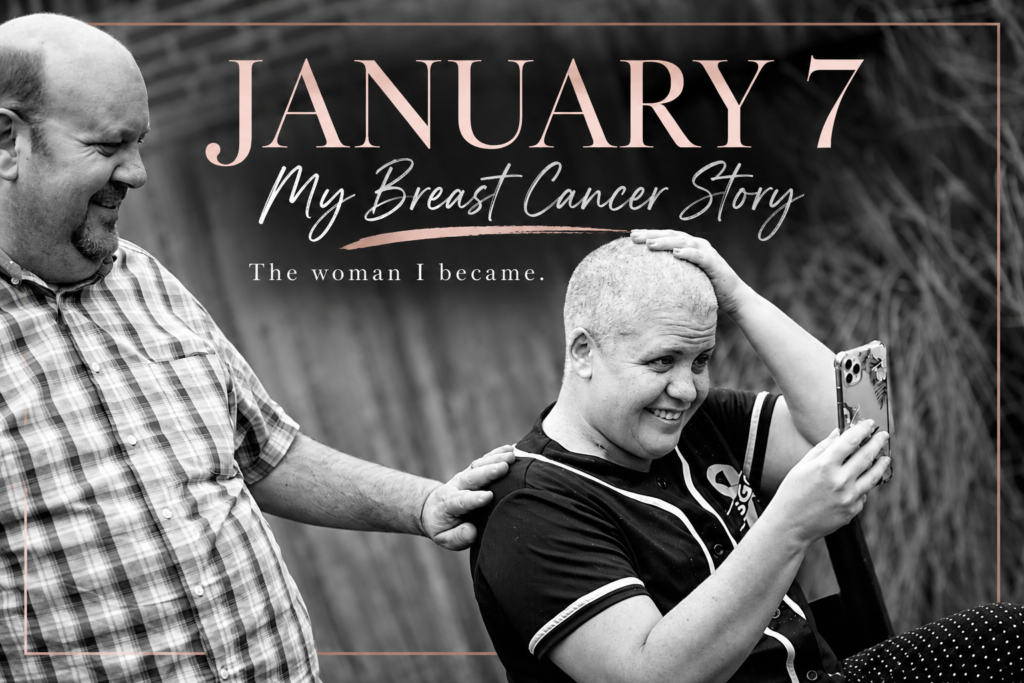
The phone call that changed my life, the people who carried me through it, and the woman I became.
There are dates in our lives that we never forget. Birthdays. Anniversaries. Milestones. Days when everything changes.
For me, January 7 will forever be one of those dates.
I can tell you exactly where I was sitting, what I was eating, and what was on my desk when the phone rang.
I was enjoying a delicious salad with romaine lettuce, shredded chicken, blueberries, feta cheese, and Olive Garden dressing. And, of course, a cold bottled Coke to balance out my healthy lunch. 😂
My phone was propped on a cute little stand, and when it rang, I immediately recognized the name.
Dr. Kristin Schmidt. My OB/GYN.
I answered, having absolutely no idea that the next few seconds would change my life.
“Stephanie, it’s Dr. Schmidt. I just got your biopsy results, and it’s not good.”
“Ok.”
“It’s breast cancer on both sides. I need you to see an oncologist. I’ve already called ahead, and she’s agreed to see you today. Are you available?”
“Yes, of course.”
That was it.
No dramatic reaction. No screaming. No falling apart.
Just “Ok” and “Yes, of course.”
I think that’s one of the strangest things about receiving life-changing news. The world doesn’t stop turning. People are still going about their day. Somewhere, someone is laughing. Someone is making dinner plans. Someone is complaining about traffic.
And you’re sitting at your desk with a half-eaten salad, trying to process the fact that you have cancer.
In both breasts.
By 3:45 that afternoon, Don and I were sitting across from Dr. Shagufta Naqvi, my oncologist. She was drawing diagrams, explaining where the cancer was, what types we were dealing with, the stages, and what would happen next.
Just hours earlier, I had been eating lunch.
Now, we were making a plan to save my life.
The Part That Hurt the Most
People often talk about how strong you have to be to fight cancer.
And they’re right.
But the hardest part of my cancer journey wasn’t necessarily the chemotherapy, the surgeries, or the physical pain.
It was watching my children hurt.
As a mom, I have always wanted to protect Avery and Piper from the things that could hurt them. I wanted their lives to be as normal as possible. I wanted them to go to school, enjoy their activities, spend time with friends, and be kids.
I certainly didn’t want them worrying about whether their mother was going to live.
But cancer doesn’t ask permission before it changes an entire family’s life.
I remember telling them about my diagnosis. I remember the tears. I remember the fear.
And I remember one particular day that will be etched into my memory forever.
The day we shaved my head.
It’s Just Hair. Until It Isn’t.
Before cancer, I had an absolutely ridiculous amount of hair.
Thick. Long. Naturally curly. More hair than any one human being should reasonably have to manage.
I complained about it constantly.
Washing it was practically an all-day event. Drying it took forever. I could wear it curly, straight, or beautifully pressed, but none of those options came without considerable effort.
And then chemotherapy came along.
My doctor told me to expect my hair to begin falling out around the tenth day after my first treatment.
She was right. Almost to the hour.
I remember taking the hair tie out of my ponytail and noticing strands of hair wrapped around it. I grabbed my brush, and suddenly my hair was coming out in huge clumps.
It was happening.
I knew I couldn’t spend the next several days watching it fall out strand by strand.
So I made a decision.
We were shaving it. That day.
One of my dearest friends, Andrea Mann, is an incredible photographer. I called and asked whether she would come document the experience.
This was during the earliest days of COVID. We were all staying home, and my immune system was practically nonexistent.
But Andrea didn’t hesitate.
“What time? I’ll be there.”
She came through our backyard gate, camera in hand, ready to capture something I didn’t yet understand would become one of the most meaningful collections of photographs of my life.
Don began cutting my hair.
I watched thick sections fall to the ground like leaves in autumn.
I had convinced myself that losing my hair wouldn’t bother me.
It’s just hair, right?
It grows back.
But somewhere between the scissors, the clippers, and the piles of hair collecting on the ground, I realized that this was so much more than a haircut.
It was a visible reminder that I was sick.
And then I looked over my shoulder.
Piper was holding her phone, recording the moment.
She was sobbing.
Not just crying. Sobbing.
The expression on her face was one of absolute heartbreak and fear.
And in that moment, I realized something I had desperately tried to avoid.
My children knew exactly how sick I was.
I hadn’t been able to protect them from that reality.
Don stopped cutting. He held me while I cried. I hugged both of my children and promised them that I would fight as hard as I possibly could.
I don’t know that I’ve ever meant a promise more.
Eventually, Don finished shaving my head.
I looked at my reflection in my phone and barely recognized the person staring back at me.
For weeks afterward, I would catch my reflection in a mirror and be startled.
But life went on.
We ate dinner. We watched television. We talked about ordinary things.
The world hadn’t stopped turning.
I was just bald.
And fighting cancer.
Cancer During a Pandemic
As if a bilateral breast cancer diagnosis wasn’t enough, my treatment coincided with the beginning of COVID-19.
I started chemotherapy the week before the world shut down.
Imagine being told that the treatments necessary to save your life would also severely compromise your immune system, just as an unfamiliar virus was spreading around the world.
It was terrifying.
Our lives changed in ways none of us could have imagined.
The activities and routines we loved disappeared. Our professional lives were disrupted. The kids lost experiences they had been looking forward to.
But something extraordinary happened in the middle of all that uncertainty.
People showed up.
Friends. Family. Neighbors.
One by one, often without knowing what anyone else was doing, people stepped in and met needs we hadn’t even realized we would have.
Food appeared. Messages arrived. Prayers were offered. Encouragement came at exactly the right moments.
It was overwhelming in the most beautiful way.
I’ve always been someone who would rather help than be helped. I’m much more comfortable taking care of everyone else.
Cancer forced me to learn something that didn’t come naturally.
Sometimes you have to let people love you by letting them help you.
And I believe with my whole heart that God was working through those people.
What initially felt like our world being turned upside down also gave us an unexpected gift.
Don was there.
Because so much of our normal professional life had stopped, he could be with me through appointments, chemotherapy treatments, and the countless side effects that followed.
He held my hand. He advocated for me. He helped me through the days when I could barely get out of the recliner.
And then came the surgery that would test both of us in an entirely different way.
Eleven Hours and One Familiar Voice
In July 2020, just weeks after completing an incredibly difficult course of chemotherapy, I underwent DIEP flap breast reconstruction.
It was an eleven-hour surgery.
Because of COVID restrictions, the procedure had to take place at a surgery center, and my insurance would cover only a 23.5-hour stay.
Don drove me there that morning.
And then he had to leave.
No waiting room. No sitting with me before surgery. No meeting me in recovery.
I walked through those doors alone, carrying my phone and a change of clothes.
I had an incredible surgical team. Two surgeons, two anesthesiologists, and nurses who were nothing short of angels.
But I was scared.
When I woke up, the nurses were checking the blood flow to my reconstructed breasts with a Doppler. They repeated those checks every thirty minutes.
I was exhausted and still heavily affected by the anesthesia.
I could hear the nurses talking about my heart rate.
It wouldn’t come down.
I remember trying to relax. Trying to slow my breathing. Trying to make my body cooperate.
Nothing worked.
And then I heard a familiar voice.
Don.
Somehow, he had convinced them to let him come see me.
I couldn’t even open my eyes, but I knew he was there.
And almost immediately, I heard someone say, “Oh, her heart rate is coming down.”
Even now, that memory makes me emotional.
My body recognized what my mind already knew.
He was my safe place.
That surgery happened on my grandmother’s birthday. I remember thinking that I absolutely could not die on her birthday.
I also had another very specific goal.
The surgery was scheduled six weeks before Avery’s first football game of his senior year.
I was determined to recover in time.
I wasn’t going to miss his senior season.
And I didn’t.
Not a single football game or contest.
Was the recovery awful?
Absolutely.
Six weeks of some of the most difficult physical recovery I’ve ever experienced.
But I had something to work toward.
And sometimes having a reason to get up, move forward, and endure one more difficult day makes all the difference.
What Cancer Took. And What It Gave Me.
I would never tell someone that cancer is a gift.
It’s not.
It’s frightening. It’s painful. It’s exhausting. It changes your body, your family, your relationships, and the way you look at the future.
There are things it takes from you that you never get back.
But I also can’t deny that some extraordinary blessings came out of the most difficult season of my life.
I learned that my body was stronger than I ever imagined.
I learned that my marriage could withstand things I never wanted it to face.
I learned that my children were watching, learning, and growing through something I desperately wished they had never experienced.
I learned that friends can become family in the most beautiful ways.
I learned that accepting help isn’t weakness.
And I learned that faith doesn’t mean you won’t be afraid.
Sometimes faith means being absolutely terrified and trusting God anyway.
The Part of Survivorship We Don’t Talk About Enough
There’s another part of my cancer story that I didn’t fully anticipate.
Survivor’s guilt.
For years, I’ve heard people ask, “Why me?” when faced with a cancer diagnosis.
My question has often been different.
“Why was I spared?”
Why did I survive when so many wonderful people didn’t?
Why did I get more birthdays, more football games, more family vacations, and more ordinary Tuesdays?
I don’t have an answer.
And I’ve learned that I may never have one.
But I’ve tried to turn those questions into something meaningful.
When someone receives a cancer diagnosis, or when someone they love begins walking that road, I want them to know they can call me.
They can ask questions. They can cry. They can be angry. They can tell me they’re scared.
I won’t pretend to have all the answers.
But I can listen.
I can share what my experience was like.
And maybe I can make someone else’s journey feel a little less lonely.
It’s one of the ways I’ve tried to make sense of being given more time.
The Woman I Became
If you asked me what changed most about me after breast cancer, my answer might surprise you.
I don’t take no for an answer anymore.
Not easily, anyway.
I’ve always been a determined person. I’ve always worked hard, set goals, and expected a lot from myself. But the woman I am today is driven and motivated in ways that the woman I was before January 7 couldn’t have imagined.
I push harder. I press further. I ask more questions. I challenge decisions. I look for another way when someone tells me something can’t be done.
And when I want something badly enough, I’m going to do everything within my power to make it happen.
Because I know what it feels like to have absolutely no control over what’s happening to your body or your life.
I know what it feels like to have your plans completely derailed in the span of one lunchtime phone call.
And I know how quickly the things you take for granted can disappear.
I don’t want to waste the time I’ve been given waiting for someone else to tell me what is possible.
That doesn’t mean I always get my way. It doesn’t mean every door opens or every dream comes true exactly as I imagined.
But a closed door doesn’t automatically mean the end of the road.
Sometimes it means finding another door.
Sometimes it means building one.
And sometimes it means deciding that the destination wasn’t nearly as important as I thought it was and finding a new direction.
I survived something that tried to take my future away from me. I’m certainly not going to sit quietly and let fear, uncertainty, or someone else’s limitations determine what I do with that future.
Cancer changed me.
It made me more intentional. More driven. More willing to take chances. More determined to live fully rather than simply be alive.
I don’t know how many years I have left. None of us do.
But I know one thing for certain.
I’m not finished. Not even close.
Dear January 7
I once wrote a letter to January 7, the date that changed my life.
I told that date it had underestimated me.
And I still believe that.
But with the perspective of time, I think there’s something else I would add.
January 7, you didn’t just underestimate me.
You underestimated my family.
You underestimated my friends.
You underestimated my faith.
You underestimated a husband who would find his way into a recovery room just so I wouldn’t have to wake up alone.
You underestimated two children whose tears would become some of my greatest motivation.
You underestimated a community of people who would show up with meals, messages, prayers, and love.
And you underestimated how determined I was to keep living the life I loved.
I wouldn’t choose to go through cancer again.
Not for a second.
But I am grateful for the life I’ve been able to live on the other side of it.
I’m grateful for every birthday, every ordinary day, every opportunity to watch my children grow, and every moment I get with the people I love.
I’m grateful that I can look at photographs of a woman with a freshly shaved head, standing in her backyard surrounded by her family, and recognize something I couldn’t fully see at the time.
She was scared.
She was heartbroken.
She had no idea what was coming next.
But she was brave.
And she was going to keep going.
January 7 changed my life.
But it never got to define it.
Isaiah 38:16–17 has remained especially meaningful to me: a reminder of restoration, God’s love, and the gift of life.
January 7 may have changed the direction of my life, but it also taught me that I’m the one who gets to decide what I do with the time I’ve been given.